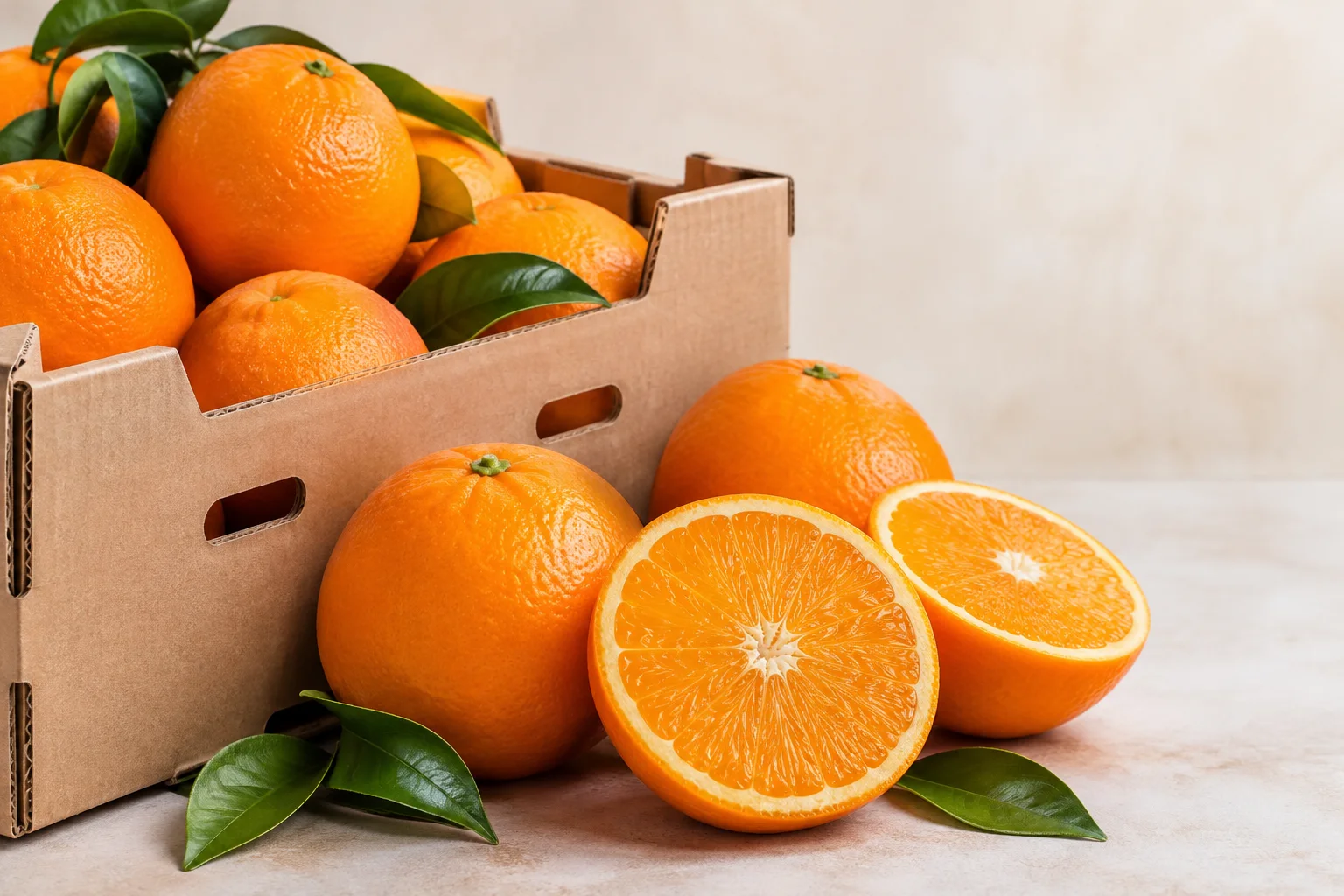
Egypt is one of the world's leading suppliers of fresh oranges, serving international wholesalers, supermarkets, distributors, and juice producers.
If you're planning to import Egyptian oranges, this guide answers 13 essential questions about Valencia and Navel varieties, export seasons, wholesale prices, quality, packaging, and international shipping.
1. Why do international buyers import oranges from Egypt?
Egypt is a major global exporter of fresh oranges, with large-scale citrus production, established packing facilities, and access to international shipping routes.
Its seasonal supply, competitive sourcing opportunities, and proximity to European, Middle Eastern, and other markets make Egyptian oranges attractive to wholesale buyers.
However, quality, price, and availability depend on the selected supplier, grade, variety, and shipment date.
2. What is the difference between Egyptian Valencia and Navel oranges?
Egyptian exporters mainly offer two internationally recognized varieties:
Navel Oranges
Naturally sweet, generally seedless or low-seed.
Popular for fresh consumption.
Suitable for supermarkets, retailers, and fresh fruit distributors.
Valencia Oranges
Known for their high juice content.
Suitable for fresh consumption and juice production.
Popular with wholesalers, food-service buyers, and juice processors.
Which variety should you import? Navel is generally preferred for fresh-eating markets, while Valencia is an excellent choice for buyers prioritizing juice content and versatile distribution.
3. When is the Egyptian orange export season?
The typical Egyptian orange export season runs from December to June, depending on variety and growing conditions.
Navel: Usually December to February or March.
Valencia: Usually January to May or June.
Additional shipments from cold storage may be available outside the main fresh-harvest window.
Exact export opening dates and shipment availability must be confirmed for each season.
4. What sizes of Egyptian oranges are available for wholesale?
Egyptian oranges are graded into different commercial sizes, often identified by counts such as:
48, 56, 64, 72, 80, 88, 100, and 113.
In common 15 kg carton specifications, these figures indicate the approximate number of oranges packed per carton. Lower counts generally represent larger fruit.
Importers should select sizes according to customer preferences, retail standards, and destination-market requirements.
5. How are Egyptian oranges packed for export?
Common export packaging includes:
15 kg telescopic cartons.
15 kg open-top cartons.
Palletized cartons suitable for refrigerated shipping.
Other carton weights and customized packaging may be available depending on the packing facility and order quantity.
Buyers should confirm carton specifications, labeling, pallet configuration, and packaging costs before placing an order.
6. What is the minimum order quantity for Egyptian oranges?
For commercial ocean shipments, suppliers commonly offer full refrigerated containers.
A 40-foot refrigerated container may carry approximately 20–25 metric tons, depending on packaging, palletization, and legal weight limits.
The actual minimum order quantity (MOQ) depends on the exporter, destination, and shipment arrangement.
Smaller or consolidated shipments may be possible when specifically arranged.
7. What is the wholesale price of Egyptian oranges?
Wholesale orange prices change throughout the season.
The final quotation depends on:
Variety: Valencia or Navel.
Fruit size and commercial grade.
Order quantity.
Packaging requirements.
Harvest and shipping dates.
Destination and freight costs.
Trade terms such as FOB or CIF.
For an accurate price, request a quotation based on your destination port, preferred variety, and required quantity.
8. How can importers verify the quality of Egyptian oranges?
Before confirming an order, buyers should request the relevant quality specifications and supporting documents.
Important checks include:
Fruit size, color, maturity, and appearance.
Quality grade and permitted defects.
Packing-house handling procedures.
Traceability information.
Pesticide-residue testing where required.
Applicable farm and packing-facility certifications.
Independent pre-shipment inspection can provide additional assurance when arranged with the supplier.
9. How are Egyptian oranges shipped internationally?
Most large commercial orders are transported by refrigerated sea containers.
Correct temperature management, ventilation, packaging, and handling help preserve fruit quality during international transportation.
Shipping arrangements may include:
FOB quotations from an Egyptian port.
CIF quotations to a designated destination port, when available.
Shipment documentation and container details.
The final refrigeration settings should follow the agreed product specifications and shipping requirements.
10. What documents are required to import oranges from Egypt?
Common export and shipping documents include:
Commercial Invoice.
Packing List.
Certificate of Origin.
Phytosanitary Certificate.
Bill of Lading.
Additional inspection, treatment, or laboratory documents where required.
Documentation varies by destination country, and importers should confirm applicable plant-health, food-safety, labeling, and customs requirements before shipment.
11. Can Egyptian oranges be imported into Russia, Europe, and Gulf countries?
Egyptian oranges are traded internationally, including in European, Middle Eastern, and other markets.
Import eligibility depends on the destination country's current regulations, approved import conditions, phytosanitary controls, and customs procedures.
Importers in Russia, the European Union, Gulf countries, or other destinations should verify current requirements before confirming a shipment.
12. Can buyers request samples or a pre-shipment inspection?
Sample arrangements, product photographs, specifications, and independent inspections may be discussed with the exporter.
Availability depends on the supplier, destination, and shipment terms.
For large orders, a documented product specification and agreed inspection procedure can help reduce quality-related disputes.
13. How can I get a wholesale quotation for Egyptian oranges?
To request a tailored quotation, prepare the following information:
Preferred variety: Valencia or Navel.
Required size and grade.
Order quantity in metric tons or containers.
Packaging requirements.
Destination country and port.
Preferred shipment date.
Preferred trade terms: FOB or CIF.
Looking to import Egyptian oranges directly from the source?
Contact ExpertExporter to discuss sourcing requirements, seasonal availability, and a quotation tailored to your market.
Request your Egyptian orange export quotation via WhatsApp.