Everything International Food Importers Need to Know Before Buying Dehydrated Onion from Egypt
Looking for a reliable Egyptian dehydrated onion supplier? Whether you manufacture seasonings, instant soups, snacks, sauces, or ready meals, choosing the right onion grade, moisture specification, packaging, and processing partner can make a significant difference to your business.
Egypt is an established international supplier of dried onion products. According to international trade data, Egypt exported approximately 37,121 metric tons of dried onions worth USD 122.5 million in 2025, with Brazil, Germany, the Netherlands, the United States, and Japan among its leading destinations.
In this guide, ExpertExporter answers the most important questions international buyers ask before importing Egyptian dehydrated onion, from particle sizes and food safety to container loading and wholesale quotations.
1. What Types of Dehydrated Onion Can You Import from Egypt?
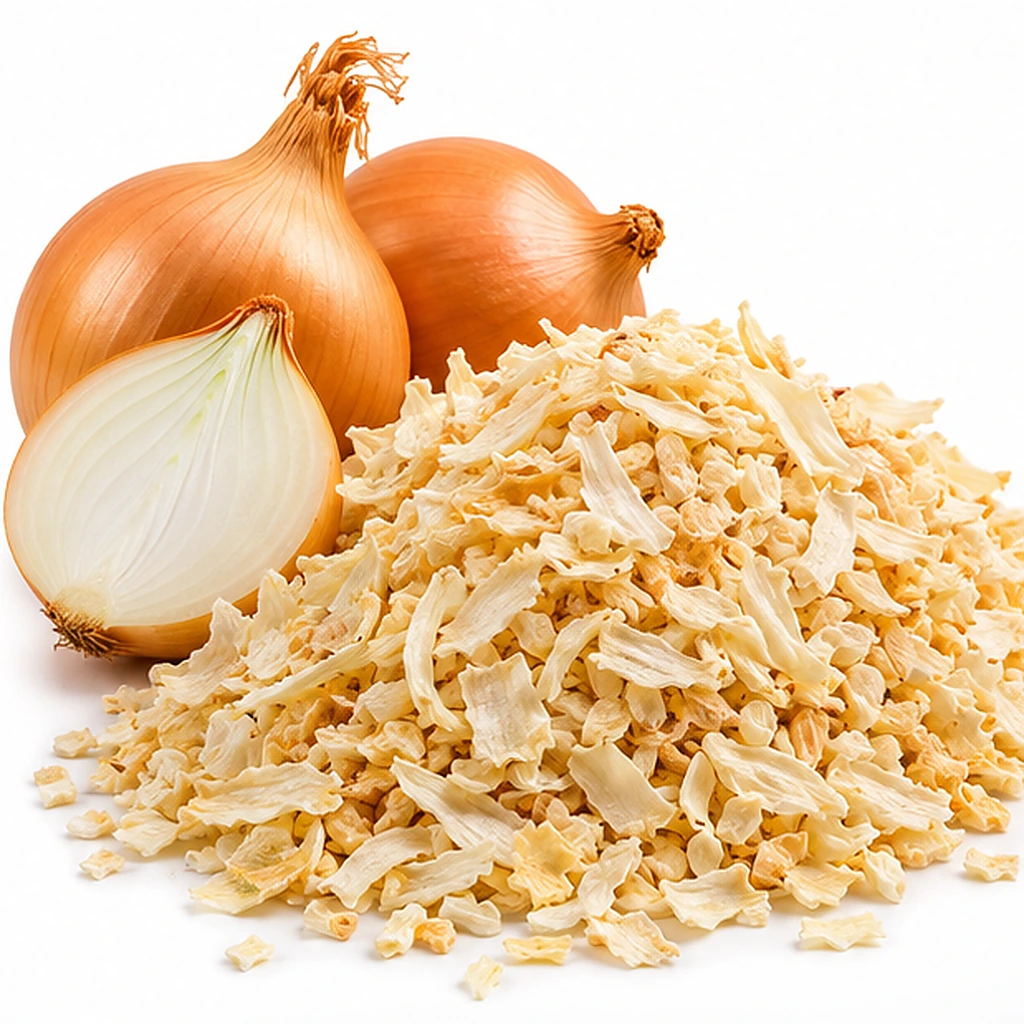
Egyptian manufacturers offer several commercial forms of dehydrated onion (Allium cepa), each suited to different food-processing applications.
| Product Form | Best Applications |
|---|---|
| Onion Flakes / Slices | Ready meals, soups, rice products, foodservice |
| Kibbled Onion | Industrial food blends, savory fillings, soups |
| Minced Onion | Seasonings, instant noodles, processed foods |
| Onion Granules | Snack coatings, spice blends, dry rubs |
| Onion Powder | Sauces, ketchup, chips, instant soups |
Which grade should you choose?
If your product requires visible onion pieces, flakes or kibbled onion may be preferable.
For even distribution in seasoning blends, granules or fine onion powder are often more suitable.
Importer Tip: Always specify the required particle size or mesh range, not just the product name.
2. How Is Egyptian Dehydrated Onion Manufactured?
The production process generally involves several controlled stages:
Raw Onion Selection: Suitable onions are selected according to variety, quality, and processing requirements.
Cleaning & Peeling: Removal of soil, outer layers, and unsuitable material.
Cutting: Onions are sliced or chopped according to the intended product form.
Controlled Dehydration: Moisture is reduced using appropriate industrial drying equipment.
Grading & Sorting: The dried product is separated by size and inspected for defects and foreign materials.
Milling: Additional processing produces granules or powder where required.
Quality Inspection & Packaging: The product is checked against agreed specifications before packing.
The final quality depends on the raw material, drying process, moisture control, hygiene, and storage conditions.
3. What Are the Most Important Export Specifications?
Before confirming any order, importers should request a Technical Data Sheet (TDS) and an appropriate Certificate of Analysis (COA).
Typical parameters to review include:
| Parameter | What Importers Should Check |
|---|---|
| Botanical Name | Allium cepa |
| Origin | Egypt |
| Available Forms | Flakes, Kibbled, Minced, Granules, Powder |
| Moisture Content | Frequently specified at maximum 6%, subject to supplier and grade |
| Color | Characteristic cream, white, or pale golden |
| Flavor & Aroma | Typical onion characteristics without unacceptable off-odors |
| Particle Size | Agreed dimensions or mesh range |
| Foreign Matter | Defined maximum limits |
| Microbiology | Limits appropriate to the buyer's market and product |
| Pesticide Residues | Compliance with applicable destination-market limits |
Important: These are purchasing parameters, not a universal guaranteed specification. Final values must be supported by the actual supplier's test results.
4. What Is the Difference Between Onion Flakes, Granules & Powder?
The main difference is particle size and the intended food-manufacturing application.
Onion Flakes
Larger dried onion pieces that remain visible in finished dishes and may be rehydrated during preparation.
Onion Granules
Smaller, more uniform particles suitable for dry seasoning blends and commercial formulations.
Onion Powder
Finely ground dried onion designed for more even flavor distribution, often without visible onion pieces.
Which is best for your production line?
Ask your production or R&D team to specify the required texture, mesh, flavor profile, and processing performance before purchasing.
5. What Packaging Is Available for Bulk Egyptian Dehydrated Onion?
Egyptian exporters commonly offer food-grade bulk packaging in several commercial formats.
Typical options include:
10 kg cartons with suitable inner liners.
20 kg bags or cartons for wholesale food ingredients.
25 kg multilayer bags with protective food-grade inner packaging.
Customized packaging for specialized industrial requirements.
Private-label retail packs, subject to manufacturer capability.
Why is packaging important?
Dehydrated onion can absorb moisture and surrounding odors if inadequately protected.
Your chosen packaging should be suitable for the product form, expected transit conditions, and storage environment.
6. What Is the Minimum Order Quantity (MOQ)?
MOQ varies by manufacturer, product grade, packaging, and processing requirements.
Some Egyptian suppliers may consider orders around 500 kg to 1 metric ton, while others prefer larger industrial or container quantities.
Customized particle sizes, special testing, or private-label production may require higher volumes.
For a precise quotation, provide:
Required product form
Quantity in kilograms or metric tons
Destination country and port
Packaging requirements
Required certificates and quality specifications
ExpertExporter can help buyers discuss suitable purchasing volumes with Egyptian suppliers.
7. How Much Dehydrated Onion Fits in a Shipping Container?
Container loading depends on product density, packaging, and applicable weight limits.
Flakes generally require more space per kilogram than fine onion powder.
Therefore, two shipments with the same net weight may require different container arrangements.
For example, some Egyptian exporters publish different loading capacities for flakes and powder, but these figures must not be treated as universal container limits.
Always request a product-specific loading plan for a 20 ft or 40 ft container before confirming a bulk shipment.
8. What Is the Shelf Life of Dehydrated Onion?
Shelf life depends on residual moisture, particle size, packaging, processing controls, and storage conditions.
Some commercial dehydrated onion products are offered with shelf lives of 24–36 months under defined conditions.
However, this is not a universal guarantee.
Importers should obtain the actual manufacturer's approved shelf-life statement and storage instructions.
Recommended Storage Principles:
Keep products in clean, cool, and dry conditions.
Protect against moisture and condensation.
Keep packaging tightly sealed.
Avoid strong odors and unsuitable storage environments.
Follow the product-specific temperature and humidity requirements.
9. Which Certificates and Laboratory Tests Should Importers Request?
Documentation requirements depend on the importing country and the particular food ingredient.
Commonly Requested Documents:
Technical Data Sheet (TDS): Product characteristics and specifications.
Certificate of Analysis (COA): Test results corresponding to the relevant batch.
Commercial Invoice & Packing List: Commercial shipment details.
Certificate of Origin: Country-of-origin documentation.
Food Safety Certificates: Where available and applicable to the actual factory.
Pesticide Residue & Microbiological Reports: When required by the buyer or destination market.
Phytosanitary or Additional Certificates: Where required by the importing country.
Important: HACCP, ISO 22000, FSSC 22000, Organic, Halal, and other certifications should only be claimed after verifying their validity, scope, and applicability to the actual manufacturer and product.
Importing into the European Union
Buyers should verify applicable pesticide maximum residue limits (MRLs), food safety requirements, labeling, and relevant product standards.
Importing into the United States
U.S. importers should assess applicable FDA requirements, including Foreign Supplier Verification Program (FSVP) obligations where relevant.
ExpertExporter can assist with requesting available supplier documentation, but final regulatory compliance must be verified for the destination market.
10. How Much Does Egyptian Dehydrated Onion Cost?
There is no single fixed export price for Egyptian dehydrated onion.
Wholesale pricing depends on:
Flakes, minced, granules, or powder
White or red onion origin
Particle size and grading
Moisture and microbiological specifications
Order quantity
Packaging
Required certifications and testing
Production season and market conditions
Delivery terms and destination
For example, a quotation for 25 kg bags of onion powder may differ significantly from one for 10 kg cartons of onion flakes.
The best approach is to request a product-specific FOB, CFR, or CIF quotation using the same technical specifications when comparing suppliers.
11. What Is the HS Code for Dehydrated Onion?
The internationally used six-digit HS code for dried onions is 071220.
This heading generally covers dried onions, including relevant whole, cut, sliced, broken, or powdered forms, provided the product meets the classification criteria.
Importer Tip: Confirm the destination country's complete tariff code, duties, and any applicable trade preferences with your customs broker before shipping.
12. Can You Import Egyptian Dehydrated Onion into Europe, Asia, or the United States?
Yes, Egyptian dried onion is already traded internationally.
Major destinations in 2025 included Brazil, Germany, the Netherlands, the United States, Japan, and Indonesia.
However, successful importation depends on meeting the destination country's applicable rules, including:
Food safety and contaminant limits
Pesticide residue requirements
Customs documentation
Importer registration or verification requirements
Labeling and product traceability
Any additional inspection or certification requirements
Existing export activity does not automatically establish that every supplier or batch is approved for every destination.
13. Can Buyers Request Samples Before Placing a Bulk Order?
Sample evaluation is strongly recommended before the first commercial shipment.
Ask for a representative sample matching the proposed bulk grade.
Where relevant, evaluate:
Color and aroma
Particle size and uniformity
Flavor performance in your recipe
Moisture and physical condition
Microbiological test results
Packaging suitability
A sample should be supported by its corresponding technical specification, with additional testing arranged when appropriate.
Approval of a sample should be followed by clear written batch specifications and acceptance criteria.
14. Is Private-Label Dehydrated Onion Available from Egypt?
Selected Egyptian manufacturers offer retail packaging and private-label production, depending on the required product and order quantity.
Potential options include:
Retail onion powder
Onion granules
Onion flakes
Custom-branded pouches
Multilingual labels
Wholesale packaging under the buyer's brand
Private-label manufacturing requires confirmation of packaging equipment, label compliance, minimum production quantities, and commercial terms.
15. How Can You Find the Right Egyptian Dehydrated Onion Supplier?
The right supplier is not simply the one offering the lowest price.
Before committing to an order, evaluate:
Factory or processing capabilities
Experience with the required product grade
Technical specification consistency
Laboratory testing and traceability
Packaging capabilities
Documentation availability
Production and delivery capacity
Responsiveness to quality requirements
ExpertExporter helps international buyers identify suitable Egyptian manufacturers and coordinate essential technical and commercial sourcing requirements.
Ready to Import Egyptian Dehydrated Onion?
Whether you need onion flakes, kibbled onion, granules, minced onion, or powder, your import project starts with a clear product specification.
To request a wholesale quotation, tell ExpertExporter:
Your destination country, preferred product form, particle size, order quantity, packaging, and required quality documents.
[Explore Premium Egyptian Dehydrated Onion in our product catalog]
Request a wholesale export quotation from ExpertExporter and explore sourcing opportunities directly from Egypt.